Under RCM you need two documents. Create both free: the Self-Invoice Generator and the Payment Voucher Generator.
What Is the Reverse Charge Mechanism?
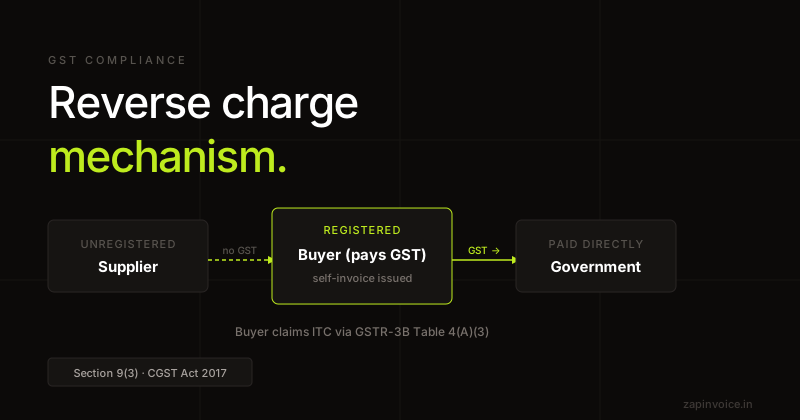
In the normal GST supply chain, the supplier charges GST on the invoice, collects it from the buyer, and deposits it with the government. Under the Reverse Charge Mechanism (RCM), this flow is reversed — the registered recipient (buyer) is responsible for calculating and depositing the GST directly, even though they are purchasing the goods or services.
RCM exists for two policy reasons: to bring unregistered suppliers into the tax net without requiring them to register, and to ensure tax compliance on certain high-risk or cross-border transactions.
RCM is governed by Sections 9(3) and 9(4) of the CGST Act (and corresponding IGST Act provisions for inter-state supply).
Two Types of RCM
Section 9(3): Notified Goods and Services
The government has specified a list of goods and services where RCM always applies — even if the supplier is GST-registered. The registered buyer must pay GST, regardless of whether the supplier charges it.
Common notified services under Section 9(3):
- Goods Transport Agency (GTA) services: Where a GTA provides transportation of goods by road. The recipient (consignor/consignee) pays 5% GST (no ITC) or 12% GST (with ITC option) under RCM.
- Legal services from an individual advocate or firm: When a business receives legal services from an advocate, the business pays 18% GST under RCM.
- Import of services from a foreign supplier: Any service received from outside India by a registered Indian business attracts IGST at 18% (or applicable rate) under RCM, regardless of whether the foreign supplier is GST-registered.
- Director's remuneration / sitting fees: Services provided by a director of a company to the company are subject to RCM at 18%.
- Security services (manpower supply): Services from an unregistered security agency attract RCM for the recipient.
- Sponsorship services: Any body corporate or partnership firm receiving sponsorship services from any person must pay GST under RCM.
- Renting of motor vehicles (passenger transport): Services from an unregistered supplier for motor vehicle rent attract RCM.
- Insurance services via Lloyd's: 18% GST under RCM.
- Services by the government to a business entity: Most government-to-business services (excluding exempt ones) attract RCM.
- Services by an author or music composer: When a publisher/music company receives services from an individual author or composer who is not registered.
Section 9(4): Purchases from Unregistered Suppliers
The original blanket RCM on all unregistered purchases was withdrawn in 2017 and has since been reinstated only for specific sectors. Currently, Section 9(4) RCM primarily applies to:
- Supplies of goods or services by unregistered suppliers to a registered promoter in the real estate sector (for construction of a project)
- Other specific categories as notified by the government from time to time
For most regular businesses, buying goods or services from an unregistered vendor does not attract RCM under Section 9(4) — only Section 9(3) notified services apply.
Documents Required Under RCM
Two documents are required for every RCM transaction:
1. Self-Invoice (Section 31(3)(f))
When purchasing from an unregistered supplier under RCM, the registered buyer must issue a self-invoice to themselves. This document:
- Is issued on the date of receipt of goods or services
- Contains the buyer's own GSTIN in both the supplier and recipient fields (with the unregistered vendor's name in a separate "Vendor" block)
- Shows the full GST that the buyer will self-deposit
- Carries the declaration: "Tax is payable on reverse charge basis"
- Must be issued to support the ITC claim — without it, ITC is unavailable even if RCM tax is paid
When the supplier is registered but the service is notified under Section 9(3), the supplier issues a regular tax invoice marked "tax payable on reverse charge basis" and the buyer does not need to issue a self-invoice — the supplier's invoice suffices for ITC.
2. Payment Voucher (Section 31(3)(g))
A payment voucher is issued by the registered buyer at the time of making payment to the unregistered supplier. It acknowledges the payment and records the GST that the buyer will deposit. It is not the ITC document (self-invoice is) — it is the payment acknowledgement.
Time of Supply Under RCM
The time of supply (when GST liability is triggered) under RCM differs from forward charge:
- For goods: Earlier of (a) date of receipt of goods or (b) date of payment or (c) 30 days from date of invoice by supplier
- For services from unregistered supplier: Earlier of (a) date of payment or (b) 60 days from date of invoice by supplier
- For import of services: Earlier of (a) date of payment or (b) date of debit in the books of account
- If time cannot be determined: Date of entry in the recipient's books of accounts
Paying RCM Tax in GST Returns
- GSTR-3B: Report RCM liability in Table 3.1(d) — "Outward taxable supplies (tax payable on reverse charge)." Enter the taxable value and tax.
- Pay via cash ledger: RCM tax must be paid by cash, not offset against existing ITC balance. This is a critical point — many businesses discover they have an ITC credit balance but still need to make a cash payment for RCM.
- Claim ITC: Once paid, claim ITC in Table 4(A)(3) of GSTR-3B in the same period or later. The ITC flows into your credit ledger and can offset future output tax.
- GSTR-1: RCM purchases are not reported in GSTR-1 (outward supply return). Only the output tax declaration in GSTR-3B matters.
ITC on RCM: Key Rules
- ITC is available on RCM tax paid — but only if the supply is used for business and not for personal/blocked purposes (Section 17(5))
- ITC can be claimed from the period the RCM tax is actually paid (not from when the liability arose)
- GTA services at 5% (without ITC option): No ITC available on the RCM tax paid
- ITC on RCM is subject to the same annual time-limit as regular ITC (30th November of the following year)
- Ensure you have the self-invoice as the supporting document before claiming ITC
Common RCM Mistakes to Avoid
- Not tracking GTA bills: Many businesses miss GTA RCM because transport is handled by logistics teams who do not flag the GST obligation.
- Using ITC to pay RCM: RCM must be paid in cash — attempting to use electronic credit ledger balance will cause errors in GSTR-3B filing.
- No self-invoice issued: Even if you paid the RCM tax, without a self-invoice you cannot claim ITC. Issue it on the date of receipt.
- Assuming all unregistered purchases trigger RCM: The blanket Section 9(4) RCM is suspended for most sectors. Only Section 9(3) notified services apply for most businesses.
- Missing import of services: SaaS subscriptions from foreign providers (AWS, Google Workspace, Figma, Notion) are imports of services and attract 18% IGST under RCM. This is frequently overlooked by startups and freelancers.
Free Self-Invoice and Payment Voucher Generator
ZapInvoice provides free generators for both RCM documents:
- Self-Invoice Generator: Pre-fills the reverse charge declaration and sets up the dual supplier/recipient block automatically.
- Payment Voucher Generator: Records the payment to the unregistered supplier with GST details — no sign-up, instant PDF.