Issue a receipt voucher when you receive an advance from a customer. GST applies on service advances; on goods advances GST is not collected (Notif 66/2017-CT).
A receipt voucher is issued under Section 31(3)(d) of the CGST Act and Rule 50 whenever a registered supplier receives an advance payment before the supply is made. It is the supplier's acknowledgement of the advance and records the GST liability arising from it.
For services, GST is payable on receipt of advance — so the receipt voucher shows the GST collected on the advance amount, and the supplier reports it in Table 11A of GSTR-1 in the month of receipt. For goods, by virtue of Notification 66/2017-Central Tax, GST is not payable at the time of advance — the receipt voucher is still issued but with no GST.
When the actual supply happens, the corresponding tax invoice references the receipt voucher and the advance is adjusted in Table 11B of GSTR-1.
When to issue a Receipt Voucher
You are a registered supplier of services and you have received an advance.
You are a registered supplier of goods who has received an advance (no GST charged on the voucher).
A retainer or partial pre-payment for any taxable supply.
Subscription pre-payments (annual / quarterly).
Fields
Mandatory fields on a Receipt Voucher
"RECEIPT VOUCHER" heading
Mandatory document title.
Voucher number & date
Unique sequential, RV- prefix recommended.
Recipient (customer) details
Name, address, GSTIN if registered.
Advance amount received
Net amount and mode of payment.
GST rate & amount
For services — based on the expected supply rate. For goods — leave at zero.
Place of supply
Determines CGST+SGST vs IGST on the advance.
How it works
Generate in 3 simple steps
1
Fill in details
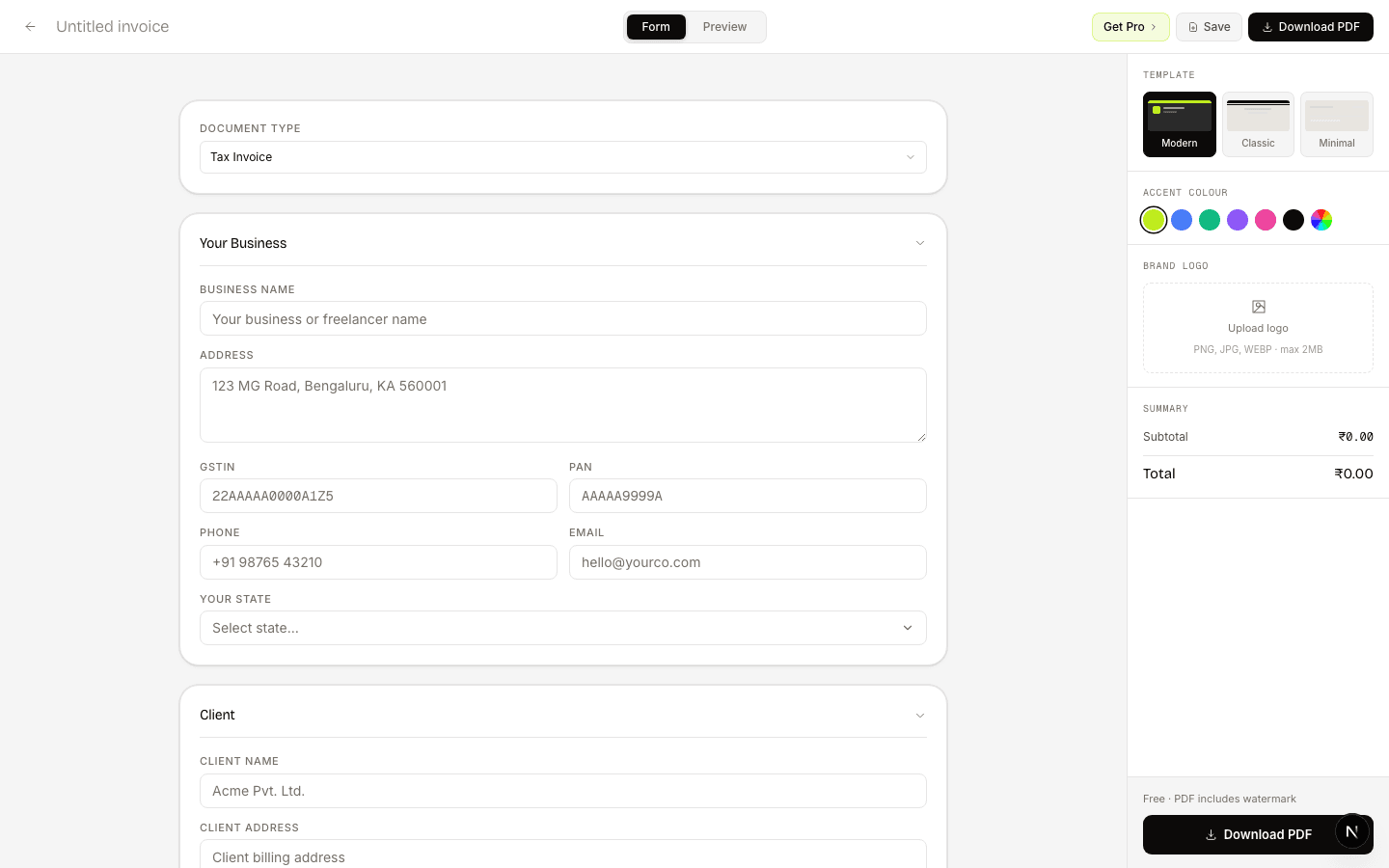
Add customer info, advance amount, expected GST rate (services), and place of supply.
2
Preview live
GST on advance is computed automatically; for goods, GST is suppressed per Notif 66/2017.
3
Download PDF
Send to the customer and report in Table 11A of your next GSTR-1.
What freelancers say
Switched from Zoho last month — haven't looked back. The CGST/SGST split is automatic, and the one-click GSTR-1 export saves my CA hours at the end of every month.
Priya MehtaFreelance UX Designer · Bengaluru
Had a cross-state client situation I was calculating wrong for months. ZapInvoice just switches to IGST automatically — no more manual guessing, no more wrong invoices.
Rahul KapoorIndependent IT Consultant · Delhi
I bill 15+ clients a month and used to chase every single one. Now ZapInvoice auto-reminds them on day 3, 7 and 14 — most pay before I even notice. Pro pays for itself.
Anita S.Owner, Kreative Digital Studio · Pune
FAQ
Frequently asked questions
Everything you need to know about receipt voucher generation.
Is GST charged on advances?
For services — yes. GST is payable in the month the advance is received. For goods — no, as per Notification 66/2017-Central Tax (effective Nov 2017). The receipt voucher is still issued, just without GST on goods.
When does the GST on a service advance become payable?
In the month the advance is received — it must be reported in Table 11A of that month's GSTR-1 and the tax paid in GSTR-3B for that month.
What happens when the supply finally takes place?
You issue a tax invoice for the full supply, adjust the advance against it, and report the adjustment in Table 11B of GSTR-1. The advance is set off, not double-counted.
What if the rate or place of supply was unknown when the advance was received?
Use 18% as the default GST rate and "inter-state" as default place of supply, as prescribed. Reconcile and adjust on the final tax invoice.
What if the supply is cancelled and I need to refund the advance?
Issue a Refund Voucher referencing the receipt voucher. The GST you paid on the advance can then be adjusted in Table 11B of GSTR-1.
Do I need a receipt voucher for a goods advance if no GST is charged?
Yes — the law still requires the supplier to issue a receipt voucher acknowledging the advance, even if the GST column is zero.
Free to use
Generate your Receipt Voucher now
No account needed. Fill in, preview, and download a PDF in under 60 seconds.