
Overview
What is an e-Way Bill?
An e-Way Bill (Electronic Way Bill) is a mandatory electronic document that must accompany the movement of goods worth more than ₹50,000 between states — and in most states, within the same state as well. It is generated on the government portal ewaybillgst.gov.in and governed by Rule 138 of the CGST Rules, 2017.
The e-Way Bill serves as electronic proof that the goods movement is legitimate and the associated supply has been properly reported to the GST system. Without a valid e-Way Bill, goods in transit can be detained by tax authorities, and the transporter is liable for a penalty of ₹10,000 or the tax amount on the goods, whichever is higher.
Importantly, an e-Way Bill is NOT a tax invoice or a delivery challan — it is a separate compliance document generated alongside one of those underlying documents. It remains valid for a fixed period based on the distance involved and must be extended if goods are not delivered within the validity window.
Use Cases
When is an e-Way Bill required?
- Movement of goods valued above ₹50,000 between two states (inter-state) — mandatory regardless of the nature of supply.
- Intra-state movement above ₹50,000 in most states (check your state's notification — some states have higher thresholds for certain goods).
- Movement under a delivery challan (job work, branch transfer, goods on approval) if the consignment value exceeds the threshold.
- Movement of goods by the recipient (buyer) who arranges their own transport after purchase.
- Movement of handicraft goods by unregistered persons between states — threshold does not apply; e-Way Bill is required even below ₹50,000.
- Over-Dimensional Cargo (ODC) — special validity rules apply (4× multiplier on days).
Fields
Mandatory fields on an e-Way Bill
GSTIN of supplier
Supplier's 15-digit GSTIN. Unregistered suppliers use "URP" (Unregistered Person).
Place of dispatch & delivery
PIN code or city/town of the origin and destination. Determines the state-to-state distance for validity.
GSTIN of recipient
Recipient's GSTIN, or "URP" if the buyer is unregistered or the supply is B2C.
Document type & number
Whether the underlying document is a tax invoice, delivery challan, bill of supply, etc., and its serial number.
HSN code
HSN code of the goods being moved. 4-digit if turnover ≤ ₹5 Cr; 6-digit otherwise.
Value of goods
Taxable value plus tax amount. Used to determine whether the ₹50,000 threshold is crossed.
Supply type & sub-type
Outward or inward supply; sub-type (supply, export, job work, SKD/CKD, etc.).
Transporter ID or vehicle number (Part B)
GSTIN of the transporter or vehicle number. Part B must be filled before goods leave the premises.
How it works
Generate in 3 simple steps
Generate your tax invoice
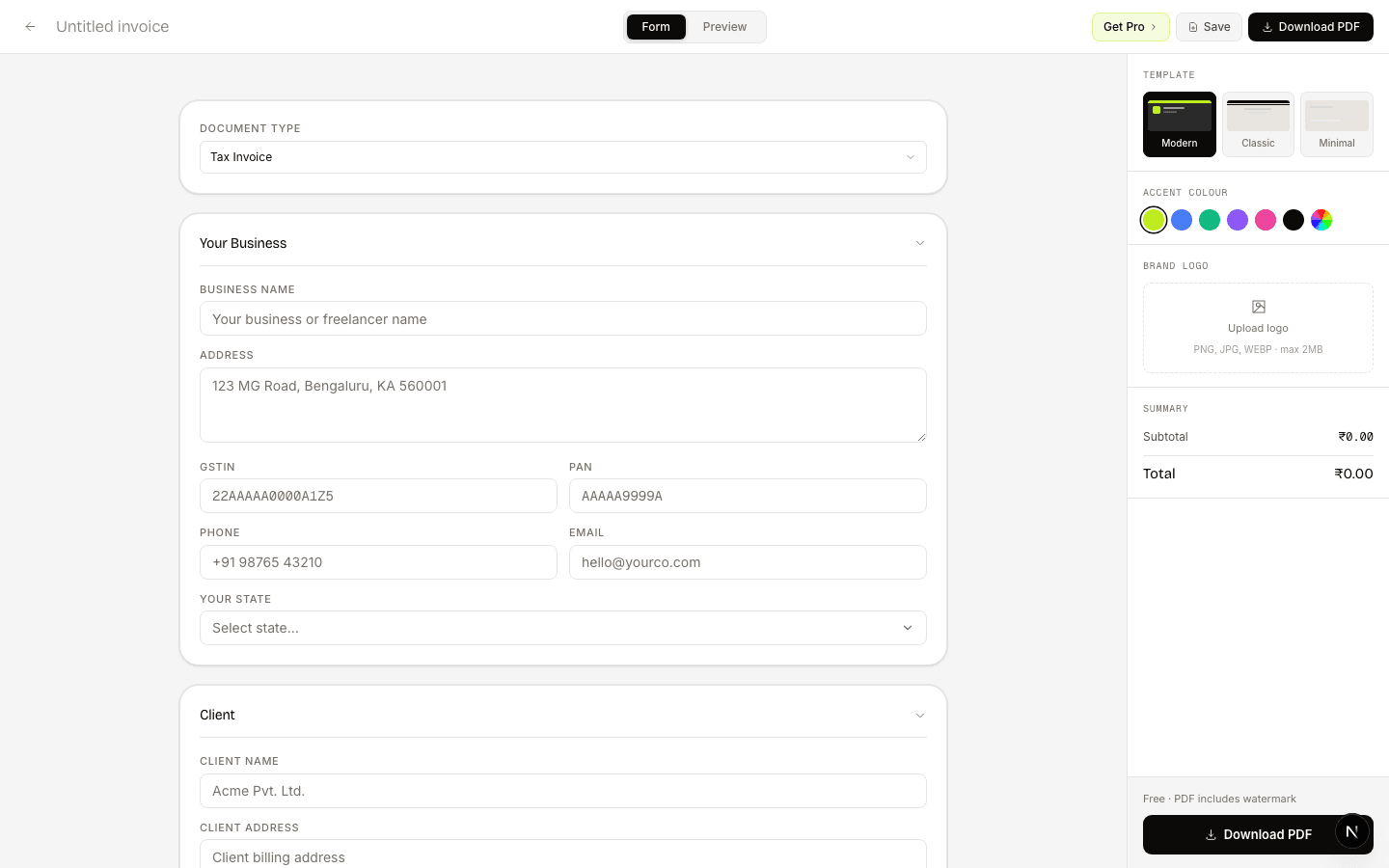
Create a GST-compliant tax invoice (or delivery challan for non-sale movement) with the correct HSN code, value, and place of supply. Use the invoice builder to produce the PDF in under a minute.
Log in to ewaybillgst.gov.in
Visit the official e-Way Bill portal (ewaybillgst.gov.in) and log in with your GSTIN credentials. Go to e-Way Bill → Generate New. Fill Part A (invoice/consignment details) and Part B (transporter/vehicle details) before the goods are dispatched.
Share EWB number with transporter
Once generated, you receive a 12-digit EWB number. Print or share it with the transporter — the EWB number must accompany the goods. Monitor validity and extend before it expires if delivery is delayed.
FAQ
Frequently asked questions
Everything you need to know about e-way bill guide generation.
What is the validity of an e-Way Bill?+
Validity is distance-based: up to 200 km = 1 day; 200–400 km = 3 days; 400–600 km = 5 days; 600–800 km = 7 days; 800–1,000 km = 9 days; above 1,000 km = 15 days. For Over-Dimensional Cargo, multiply all these by 4. Validity starts from midnight of the generation date. You can extend before it expires — extension is allowed from 8 hours before to 8 hours after expiry.
Who is responsible for generating the e-Way Bill?+
Primarily the consignor (supplier/seller). If the supplier does not generate it, the transporter must generate the e-Way Bill before moving the goods. The buyer (consignee) can also generate it if they are transporting the goods themselves after purchase.
What is the difference between Part A and Part B of an e-Way Bill?+
Part A contains the consignment details — supplier/recipient GSTINs, document number, HSN, value, and place of dispatch/delivery. Part B contains the vehicle details — transporter GSTIN or transport ID and vehicle number. Part A can be saved in advance; Part B must be filled in before the goods physically move. Without Part B, the e-Way Bill is incomplete and goods cannot legally be transported.
When is an e-Way Bill NOT required?+
Exemptions include: goods transported by non-motorised vehicles; goods carried by a person as personal baggage; movement of goods from customs port to CFS/ICD; certain goods listed in Annexure to Rule 138 (e.g. vegetables, fruits, unprocessed agricultural produce, household effects during relocation); transport of exempted goods; movement within the same state below the state-specific threshold; and movement within 50 km of the supplier's premises in certain intra-state cases.
Can an e-Way Bill be cancelled?+
Yes, but only within 24 hours of generation, and only if the goods have not already been verified by a tax officer. After 24 hours or post-verification, the e-Way Bill cannot be cancelled. If you generated it in error after that window, let it expire — do not transport goods against it.
What is the penalty for not having an e-Way Bill?+
Under Section 129 of the CGST Act, goods being moved without a valid e-Way Bill are liable to detention. The penalty is the higher of: (a) 100% of the tax amount on the goods, or (b) ₹10,000 per instance. For goods that are exempt from tax, the penalty is 2% of the goods' value or ₹25,000, whichever is lower.
For job work, does the delivery challan trigger an e-Way Bill requirement?+
Yes. Even though no sale occurs, if the goods being sent for job work are valued above ₹50,000, an e-Way Bill must be generated using the delivery challan as the underlying document (select "Delivery Challan" as the document type on the portal). The challan number and date appear in Part A.
Free to use
Generate the Tax Invoice first
Every e-Way Bill starts with a valid tax invoice. Create your GST-compliant invoice in under 60 seconds — then generate the e-Way Bill on the government portal.
Related