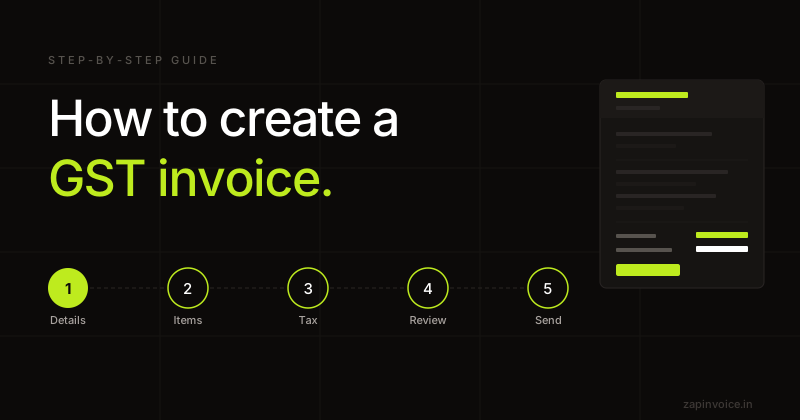
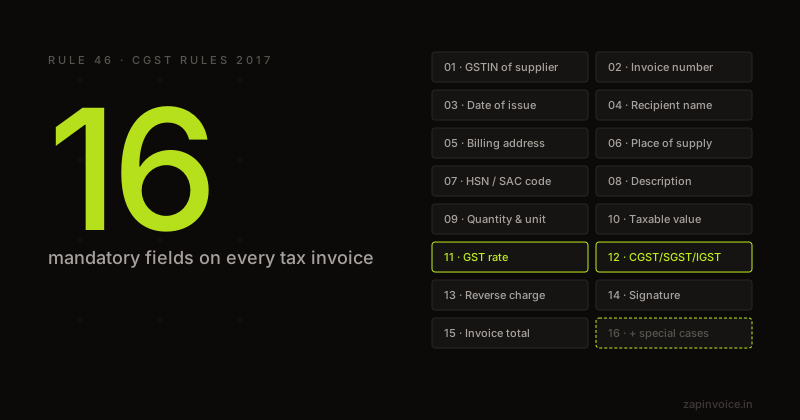
Don't want to memorise 16 fields? The free GST Invoice Generator includes every Rule 46 field by default — just fill in your details.
What Is Rule 46 of the CGST Rules?
Rule 46 of the Central Goods and Services Tax (CGST) Rules 2017 defines the mandatory contents of a tax invoice issued under Section 31 of the CGST Act. It applies to all GST-registered businesses making taxable supplies of goods or services.
The government has not prescribed a specific visual template — you can use any layout. What matters is that your invoice contains every required field. Missing even one field can invalidate your buyer's Input Tax Credit (ITC) claim.
All 16 Mandatory Fields — Detailed Breakdown
1. Supplier Details
- Name — Legal business name as registered with GST
- Address — Registered address (must match GST registration)
- GSTIN — 15-character GST identification number
2. Invoice Serial Number
Must be consecutive and unique for each financial year. Maximum 16 characters. Can include letters, numbers, /, -, and special characters. Recommended format: ZAP/2026-27/001
3. Date of Issue
The date the invoice is issued — not the date of contract or delivery. For continuous services, the date must be on or before each payment due date.
4. Recipient Details
- Name and address of the registered buyer
- GSTIN of the recipient (mandatory for B2B; optional for B2C if value below ₹2.5 lakh)
- State name and code of the recipient
5. Place of Supply
The state where the supply is deemed to occur — determines whether CGST+SGST or IGST applies. For services, this is typically the recipient's state. For goods, it's the destination state.
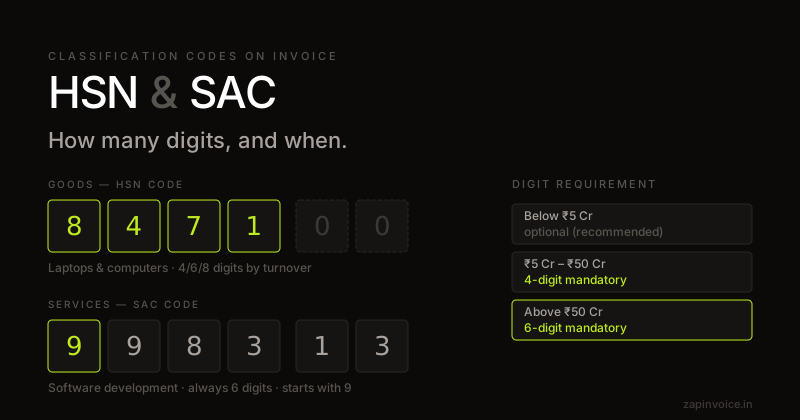
6. HSN Code (Goods) / SAC Code (Services)
- Turnover up to ₹5 crore — HSN/SAC optional (but recommended)
- ₹5 crore to ₹50 crore — 2-digit HSN/SAC code required
- Above ₹50 crore — 4-digit HSN/SAC code required (e-invoicing also applies)
- E-invoice mandated taxpayers (₹5 crore+) must use 6-digit HSN
7. Description of Goods/Services
A clear description of what was supplied. For goods, include brand name, model, or specification. For services, describe the nature of service rendered.
8. Quantity and Unit
Required for goods (e.g., 50 Nos, 10 Kg). For services, quantity is typically 1 and unit is "Service" or "Hour".
9. Total Value (before tax)
The taxable value of the supply — after any discounts, before tax. This is the base on which GST is calculated.
10. Tax Rate
GST rate applied: 0%, 5%, 12%, 18%, or 28%. Must be shown separately for CGST, SGST/UTGST, and IGST.
11. Tax Amount
The actual rupee amount of tax charged — broken down by CGST, SGST/UTGST, and IGST. All three columns must appear on the invoice, even if some show zero.
12. Reverse Charge Indicator
A clear "Yes/No" field indicating whether the tax is payable on a reverse charge basis. Mandatory even if the answer is No.
13. Delivery Address (if different from billing)
If goods are delivered to a location different from the billing address (e.g., a warehouse or project site), that address must appear on the invoice.
14. Signature of Supplier
Physical signature, digital signature (DSC under IT Act), or printed name of authorized signatory. Electronic invoices sent via email typically use the printed name.
15. Total Invoice Value
The grand total — taxable value + all taxes + any other charges (e.g., freight, packing). This is what the buyer owes.
16. Additional Fields for Specific Cases
- Exports: Shipping bill number, port of export, and "SUPPLY FOR EXPORT" declaration
- SEZ supplies: "SUPPLY TO SEZ UNIT/DEVELOPER" with LUT/bond reference
- E-invoices: IRN (Invoice Reference Number) and QR code generated by IRP
Number of Copies Required
- Supply of goods — 3 copies: Original (buyer), Duplicate (transporter), Triplicate (supplier)
- Supply of services — 2 copies: Original (buyer), Duplicate (supplier)
- Each copy must be clearly labelled (Original, Duplicate, Triplicate)
Invoice Number Format — Best Practices
While any format is legal, a well-structured invoice number helps with reconciliation:
ZAP/2026-27/001— company prefix + financial year + serialINV-00142— simple running number2026-27/B2B/001— categorized by supply type
Always restart numbering at 001 at the start of each financial year (April 1). You can maintain separate series for different supply types (e.g., goods vs services), but each series must be internally sequential.
E-Invoice Requirements (₹5 Crore+ Turnover)
Businesses with aggregate turnover above ₹5 crore must generate e-invoices through the Invoice Registration Portal (IRP). The IRP returns an IRN (Invoice Reference Number) and a digitally signed QR code that must be printed on the invoice. Failure to comply results in the invoice being treated as invalid for ITC purposes.