Need to issue one right now? Use the free Credit Note Generator or Debit Note Generator — both auto-fill the original-invoice reference fields that GSTR-1 expects.
Why You Need Credit and Debit Notes
Under GST, once a tax invoice is issued and filed in GSTR-1, it cannot be edited or cancelled. If you discover an error — wrong amount, rate, or quantity — or if goods are returned, you need a formal correction document. Section 34 of the CGST Act provides for:
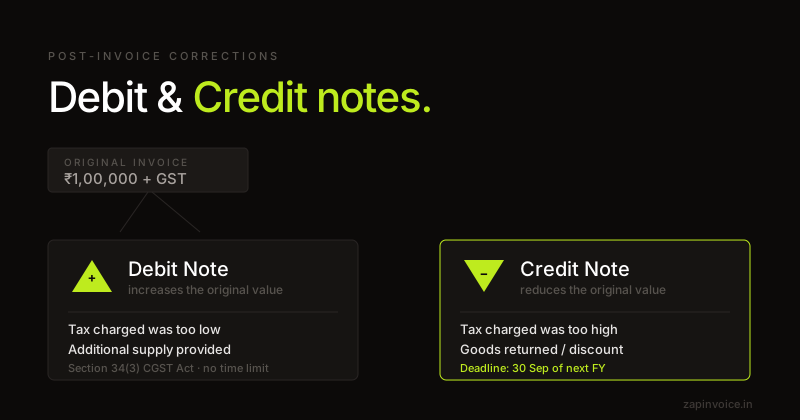
- Credit Note — issued when the invoice value needs to be reduced
- Debit Note — issued when the invoice value needs to be increased
Credit Note Under GST
When to Issue a Credit Note
- Tax was charged higher than the actual taxable value
- Goods are returned by the buyer (sales return)
- Services were found to be deficient or not delivered as per contract
- Post-supply discount was agreed upon after invoice issuance
- Invoice was issued for a cancelled order
Effect of a Credit Note
When you issue a credit note, your output tax liability decreases. Consequently, the buyer must reverse the ITC claimed on the original invoice by the corresponding amount. Both adjustments are reported in GSTR-1 and GSTR-3B respectively.
Time Limit for Credit Note
This is critical: a credit note reducing tax must be issued by the earlier of:
- 30 September of the financial year following the year in which the supply was made
- The date of filing the annual return (GSTR-9)
Example: For a supply in March 2026, the credit note must be issued by September 30, 2026. If you miss this window, you can still issue a commercial credit note (to adjust the amount owed), but you cannot reduce your GST liability — you'll have to bear the excess tax.
Debit Note Under GST
When to Issue a Debit Note
- Tax was charged lower than the actual taxable value
- Additional goods/services were provided after the original invoice
- Post-supply price increase was agreed upon
- A calculation error understated the invoice amount
Effect of a Debit Note
When you issue a debit note, your output tax liability increases. The buyer gains additional ITC equal to the tax shown on the debit note (subject to normal ITC eligibility conditions). Both are reflected in GSTR-1 and GSTR-3B.
Time Limit for Debit Note
There is no specific time limit for issuing a debit note under the GST law. However, the buyer's ITC claim on the debit note is subject to the Section 16(4) deadline (filing of September return of the next financial year).
Mandatory Fields on a Credit/Debit Note
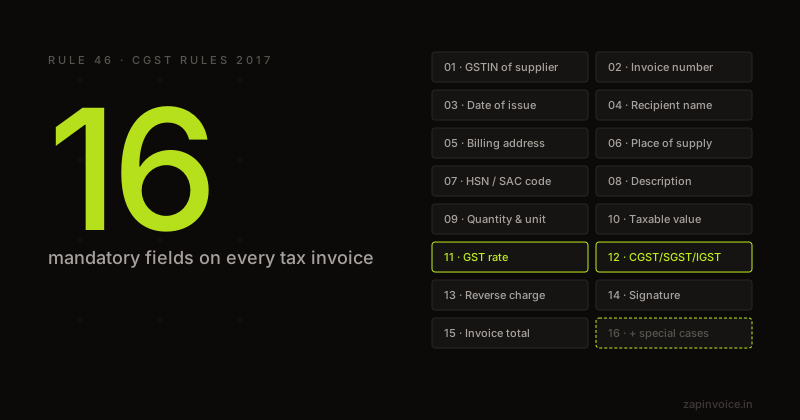
- The words "Credit Note" or "Debit Note" clearly displayed
- Name, address, and GSTIN of the supplier
- Name, address, and GSTIN of the recipient (if registered)
- Serial number (separate series from invoices; max 16 characters)
- Date of issue
- Original invoice number and date — mandatory reference
- Taxable value of goods/services adjusted
- Rate and amount of GST adjusted (CGST/SGST/IGST separately)
- Reason for issuance
- Signature of supplier
Reporting in GSTR-1
- Credit notes for registered buyers (B2B): Table 9B — Credit/Debit Notes (Registered)
- Credit notes for unregistered buyers (B2C): Table 9B — Credit/Debit Notes (Unregistered)
- Debit notes: Same tables, reported with positive adjustment values
- Both are auto-populated in the buyer's GSTR-2B for reconciliation
Practical Examples
Example 1 — Price Error (Credit Note)
You issued an invoice for ₹1,00,000 + 18% GST = ₹18,000 GST. Later you realize the agreed price was ₹90,000. Issue a credit note for ₹10,000 + ₹1,800 GST (18% of ₹10,000). Your GSTR-1 shows a credit note of ₹10,000 against the original invoice; the buyer must reverse ₹1,800 ITC.
Example 2 — Goods Return (Credit Note)
You sold 100 units at ₹500 each; the buyer returns 20 defective units. Issue a credit note for 20 units × ₹500 = ₹10,000 + applicable GST. Reference the original invoice number on the credit note.
Example 3 — Undercharging (Debit Note)
You invoiced a client ₹50,000 for 100 hours of consulting. After review, you realize the actual hours were 110. Issue a debit note for ₹5,000 (10 hours × ₹500) + 18% GST = ₹900. The client's ITC increases by ₹900.