
Overview
What is a Credit Note under GST?
A credit note is issued by a supplier to a buyer when the taxable value or tax charged on the original tax invoice was higher than what was actually payable. This happens in three common situations: goods are returned, a post-sale discount is given, or the supply turned out to be deficient.
Under Section 34 of the CGST Act, a credit note must reference the original tax invoice and reduces the supplier's output GST liability — but only if the buyer has reversed the corresponding ITC. It is reported in Table 9B of GSTR-1 (registered) or Table 9B/9C (unregistered).
The deadline to issue a credit note is the earlier of: 30th November of the year following the financial year of the original invoice, or the date of filing the annual return.
Use Cases
When to issue a Credit Note
- Goods are returned by the buyer (sales return).
- You agreed a post-sale discount that was not on the original invoice.
- Services were deficient and you are giving a partial refund.
- The original invoice over-charged GST (wrong rate, wrong taxable value).
- The supply was cancelled after invoicing.
Fields
Mandatory fields on a Credit Note
"CREDIT NOTE" heading
Mandatory document title.
Credit note number & date
Unique sequential, separate series (CN-) recommended.
Original invoice reference
Number and date of the tax invoice being adjusted — mandatory.
Reason for issue
Sales return, post-sale discount, deficient supply, etc.
Place of supply
Same as the original invoice — determines CGST+SGST vs IGST reversal.
Taxable value reduction & GST reversed
Per-line reduction with rate, CGST, SGST/UTGST, IGST shown separately.
How it works
Generate in 3 simple steps
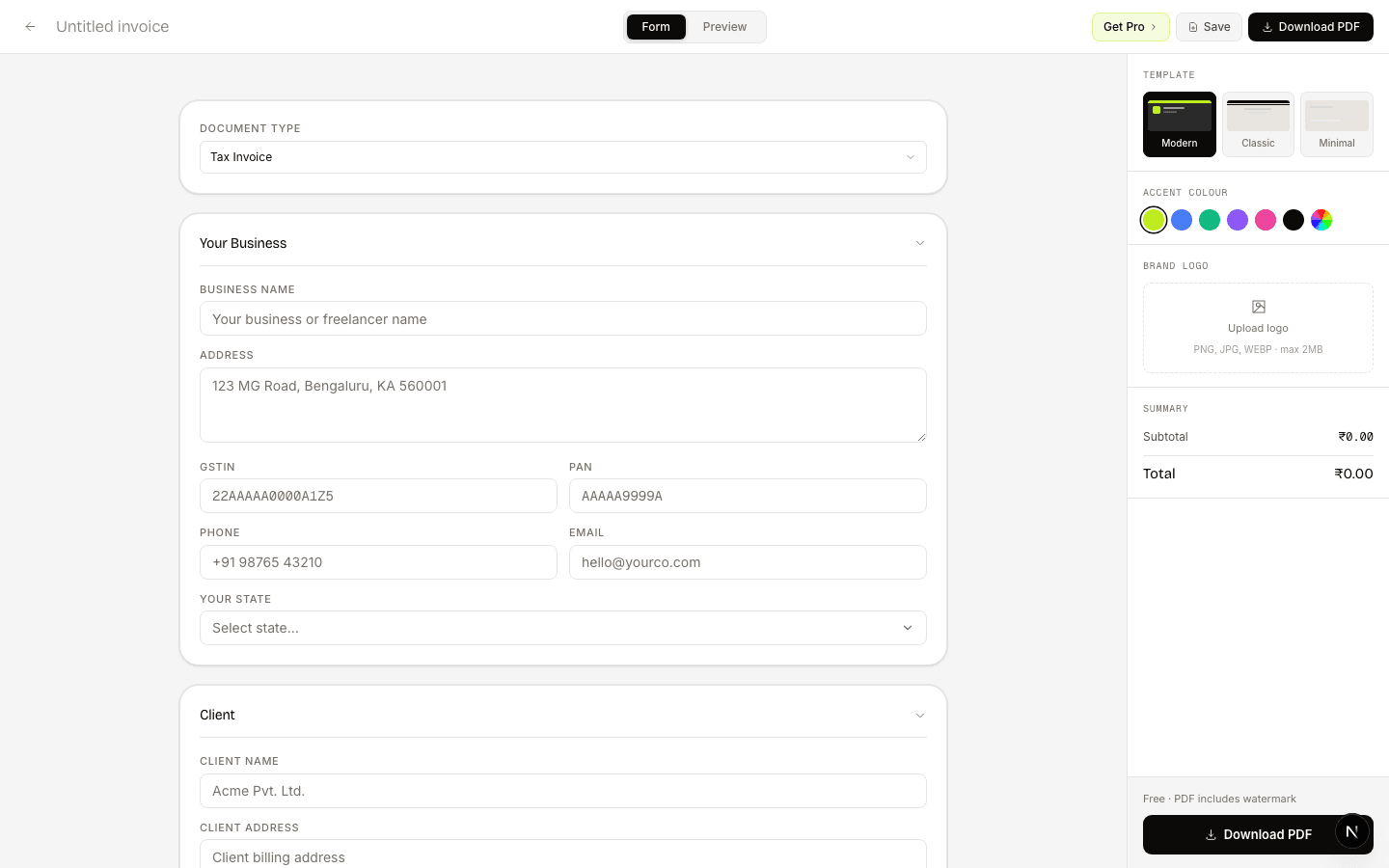
Fill in details
Reference the original invoice number and date, pick a reason code, and enter the values being credited.
Preview live
CGST/SGST/IGST reversal mirrors the original invoice automatically.
Download PDF
Send the PDF to the buyer and report it in Table 9B of your next GSTR-1.
FAQ
Frequently asked questions
Everything you need to know about credit note generation.
When can I issue a credit note?+
Up to 30th November of the year following the financial year of the original invoice, or the date of filing your annual return — whichever is earlier. Beyond that, you cannot reduce GST liability via a credit note.
Do I need to link a credit note to an invoice?+
Yes. The original invoice number and date are mandatory on every credit note. Without the reference, the credit note is invalid.
Where do I report a credit note in GSTR-1?+
Table 9B for credit notes issued to registered buyers; Table 9B / 9C for unregistered buyers (and amendments). Our PDF labels the type so your accountant can pick the right table.
Will my output GST automatically reduce?+
Your output liability reduces only if the buyer has reversed the corresponding ITC. If they haven't, you cannot claim the reduction.
Can I issue a credit note without GST?+
Yes — a commercial credit note (no GST adjustment) can be issued at any time. It just won't reduce your output tax liability. Use this for goodwill discounts after the deadline.
What is the difference between a credit note and a refund voucher?+
A credit note adjusts a tax invoice for completed supply. A refund voucher refunds an advance (where you had issued a receipt voucher) and the supply never happened.
What freelancers say
Switched from Zoho last month — haven't looked back. The CGST/SGST split is automatic, and the one-click GSTR-1 export saves my CA hours at the end of every month.
Priya Mehta
Freelance UX Designer · Bengaluru
Had a cross-state client situation I was calculating wrong for months. ZapInvoice just switches to IGST automatically — no more manual guessing, no more wrong invoices.
Rahul Kapoor
Independent IT Consultant · Delhi
I bill 15+ clients a month and used to chase every single one. Now ZapInvoice auto-reminds them on day 3, 7 and 14 — most pay before I even notice. Pro pays for itself.
Anita S.
Owner, Kreative Digital Studio · Pune
Free to use
Generate your Credit Note now
No account needed. Fill in, preview, and download a PDF in under 60 seconds.
Related