
GST Basics
Tax Invoice vs Bill of Supply: Key Differences Under GST
Not every GST business issues a tax invoice. Here's when to use a bill of supply instead, and what fields each document requires.
29 Jan 20267 min read

The right document for composition-scheme dealers and for exempt or nil-rated supplies. No GST is charged and the buyer cannot claim ITC.
Overview
A bill of supply is issued under Section 31(3)(c) of the CGST Act and Rule 49 of the CGST Rules. It is the correct document — instead of a tax invoice — when no GST can be charged: either because the supplier is registered under the composition scheme, or because the supply is exempt or nil-rated.
A bill of supply must carry the words "BILL OF SUPPLY" and, for composition dealers, the declaration: "Composition taxable person, not eligible to collect tax on supplies." Because no GST is charged, the buyer cannot claim Input Tax Credit on the document.
It is reported in GSTR-1 Table 8 (Nil-rated, exempt, non-GST supplies) or in the composition return GSTR-4 / CMP-08 depending on the scheme. If a supply line includes both taxable and exempt items, you can issue a single "invoice-cum-bill of supply".
Fields
How it works
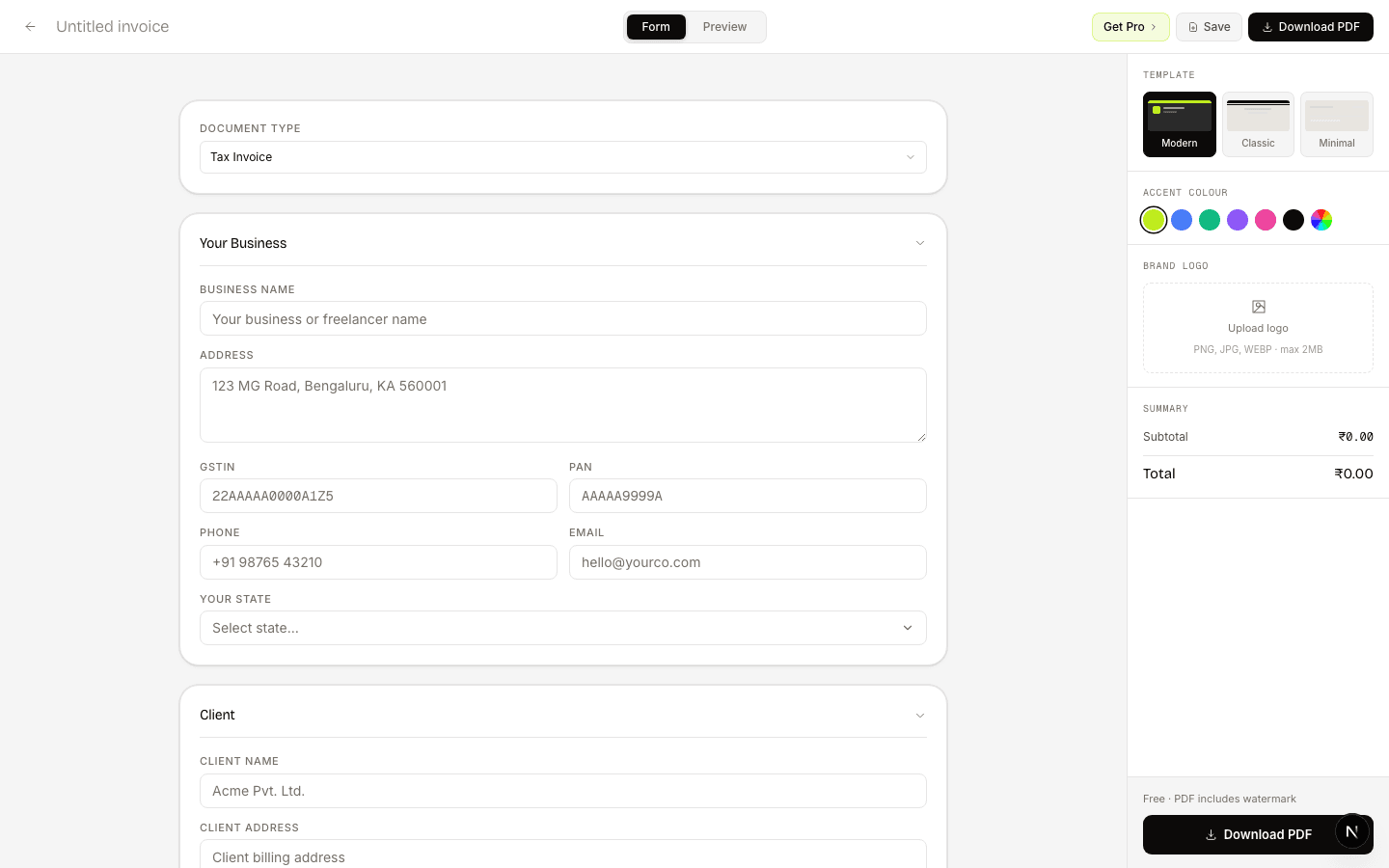
Add your business details, the buyer, and the line items. GST columns are hidden automatically.
See the composition declaration and bill-of-supply format render in real time.
Download a clean, GST-compliant PDF. Report it in GSTR-1 Table 8 or CMP-08.
What freelancers say
Switched from Zoho last month — haven't looked back. The CGST/SGST split is automatic, and the one-click GSTR-1 export saves my CA hours at the end of every month.
Had a cross-state client situation I was calculating wrong for months. ZapInvoice just switches to IGST automatically — no more manual guessing, no more wrong invoices.
I bill 15+ clients a month and used to chase every single one. Now ZapInvoice auto-reminds them on day 3, 7 and 14 — most pay before I even notice. Pro pays for itself.
FAQ
Everything you need to know about bill of supply generation.
Yes — for exempt or nil-rated supplies. Even if you are a normal registered taxpayer, you must issue a bill of supply (not a tax invoice) for any exempt items.
No. Because no GST is charged on the document, the buyer has nothing to claim as Input Tax Credit.
A tax invoice is for taxable supplies and shows GST (which the buyer can claim as ITC). A bill of supply is for exempt supplies or composition dealers — no GST is shown and no ITC is available.
Yes, the same HSN length rules apply (4-digit if turnover ≤ ₹5 Cr B2B, 6-digit otherwise).
It is strongly recommended. Keep a BOS- series for bill of supply distinct from your INV- tax invoice series so reconciliation in GSTR-1 is clean.
If a single supply has both taxable and exempt items, you can issue a combined document titled "Invoice-cum-Bill of Supply" instead of two separate documents. It must show GST only on the taxable lines.
Free to use
No account needed. Fill in, preview, and download a PDF in under 60 seconds.
Guides
Not every GST business issues a tax invoice. Here's when to use a bill of supply instead, and what fields each document requires.

The GST composition scheme lets eligible small businesses pay tax at a flat rate and file just one annual return. Here is everything you need to know to decide if it works for you.

The complete GST invoice format under Rule 46 — every mandatory field explained with examples and compliance tips.