A self-invoice is issued by a registered buyer to themselves when receiving goods or services from an unregistered supplier in a reverse-charge transaction. Section 31(3)(f) of the CGST Act requires the recipient to issue this invoice on the date of receipt — because the unregistered supplier cannot issue a tax invoice.
The self-invoice is the document that supports the buyer's ITC claim on the RCM tax. Without a self-invoice, no ITC is available on RCM tax deposited — so issuing it is not optional.
It is similar in form to a tax invoice but the supplier and recipient blocks both contain the buyer's details (with the unregistered supplier in a separate 'Vendor' block), and it carries the reverse-charge declaration. It is not reported in GSTR-1; the corresponding ITC is claimed in Table 4(A)(3) of GSTR-3B.
When to issue a Self-Invoice
Purchases of notified RCM goods/services from unregistered suppliers (legal services, GTA, security services, sponsorship, etc.).
Import of services from a foreign supplier (which is treated as RCM).
Whenever you are paying GST under RCM and intend to claim ITC.
Director's remuneration / sitting fees (RCM for companies).
Fields
Mandatory fields on a Self-Invoice
"SELF-INVOICE" heading
Mandatory document title.
Invoice number & date
Unique sequential, SI- prefix recommended. Issued on date of receipt of supply.
Buyer (recipient) details
Your business name, address, GSTIN.
Vendor (unregistered supplier) details
Name and address of the unregistered supplier.
HSN / SAC, description, value, GST
Standard tax-invoice columns — full GST self-charged.
Reverse charge declaration
"Tax is payable on reverse charge basis." printed automatically.
How it works
Generate in 3 simple steps
1
Fill in details
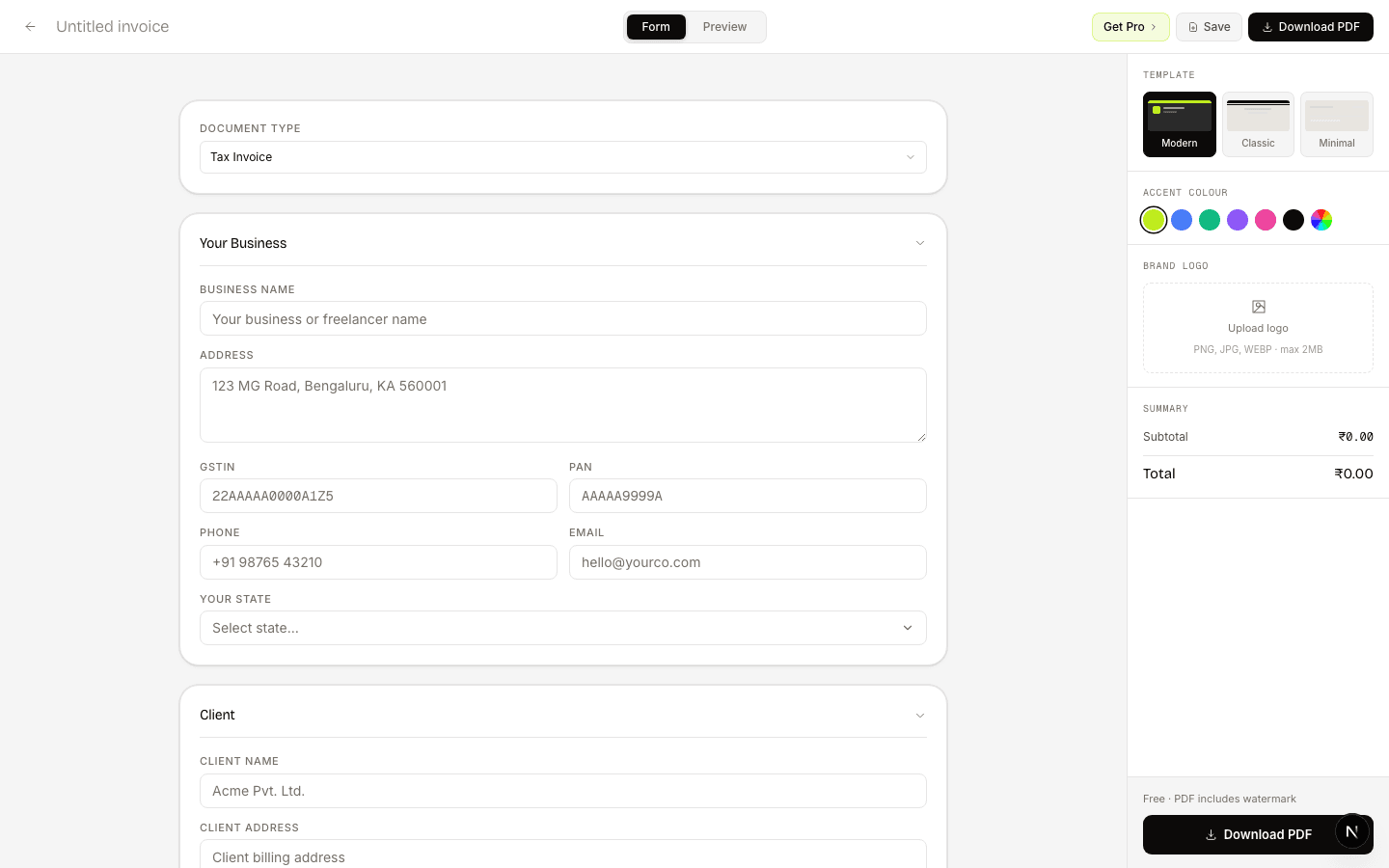
Add vendor (unregistered) info, supply description, and the GST rate you will self-deposit.
2
Preview live
The self-invoice format puts your own business in the recipient block; vendor details go in the supplier block.
3
Download PDF
Pair with a Payment Voucher for the payment. Claim ITC in GSTR-3B Table 4(A)(3).
What freelancers say
Switched from Zoho last month — haven't looked back. The CGST/SGST split is automatic, and the one-click GSTR-1 export saves my CA hours at the end of every month.
Priya MehtaFreelance UX Designer · Bengaluru
Had a cross-state client situation I was calculating wrong for months. ZapInvoice just switches to IGST automatically — no more manual guessing, no more wrong invoices.
Rahul KapoorIndependent IT Consultant · Delhi
I bill 15+ clients a month and used to chase every single one. Now ZapInvoice auto-reminds them on day 3, 7 and 14 — most pay before I even notice. Pro pays for itself.
Anita S.Owner, Kreative Digital Studio · Pune
FAQ
Frequently asked questions
Everything you need to know about self-invoice generation.
Why do I need a self-invoice if I already issued a payment voucher?
The payment voucher records the payment to the supplier; the self-invoice is the tax-invoice equivalent that supports your ITC claim. Both are needed under RCM — they're two halves of the same transaction.
Can I claim ITC without a self-invoice?
No. ITC on RCM tax is only available if the recipient has issued a self-invoice for the supply. Skipping it forfeits the credit, even if you have paid the GST.
When should the self-invoice be dated?
On the date of receipt of the goods or services — Section 31(3)(f) is clear that it must be issued at the time of receipt.
Is a self-invoice reported in GSTR-1?
No. It is not an outward supply. The RCM output tax is reported in GSTR-3B Table 3.1(d), and the matching ITC is claimed in GSTR-3B Table 4(A)(3).
Does it apply to registered supplier RCM cases too?
No — when the supplier is registered, they issue a tax invoice mentioning "tax payable under reverse charge" and the buyer does not need a self-invoice. Self-invoice is only for unregistered-supplier RCM.
Can I issue a single consolidated self-invoice for the month?
Yes. For multiple unregistered RCM purchases in a month, you can issue one consolidated self-invoice at month-end covering all such supplies — provided each vendor is listed separately.
Free to use
Generate your Self-Invoice now
No account needed. Fill in, preview, and download a PDF in under 60 seconds.