Need to issue a GST-compliant invoice today? Skip the spreadsheets — use our free GST Invoice Generator to create a CBIC Rule 46 compliant invoice (with CGST/SGST/IGST auto-split and UPI QR) in under 60 seconds. No sign-up, no watermark.
What Is an E-Invoice?
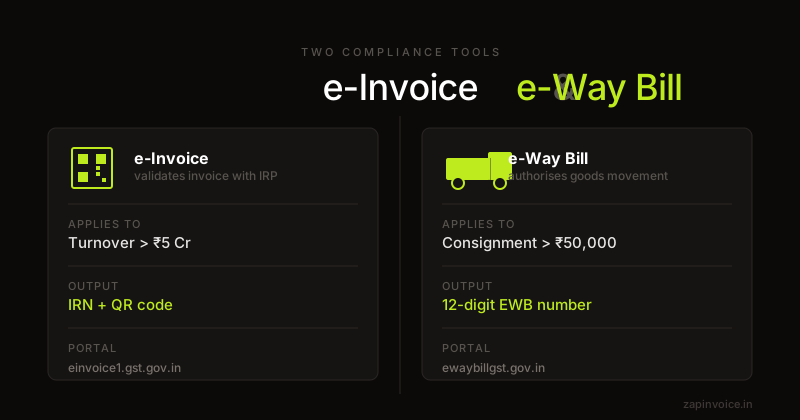
E-invoice (Electronic Invoice) is a system where B2B invoices are authenticated by the government's Invoice Registration Portal (IRP) before being used in commerce. The IRP generates a unique Invoice Reference Number (IRN) and a digitally signed QR code that must appear on every e-invoice.
Key point: E-invoice is not a new format. You still create your invoice as usual — the difference is that the invoice data is reported to the IRP, which validates it and returns a unique IRN. This IRN-stamped invoice is then sent to your buyer.
Applicability (2026):
- Mandatory for businesses with aggregate turnover above ₹5 crore
- Applies to all B2B invoices, debit notes, and credit notes
- Does NOT apply to B2C invoices, exports directly (though IRN is recommended), or invoices from exempted categories
- SEZ units, insurance companies, banks, NBFCs, and GTA are currently exempt from e-invoicing
What Is an E-Way Bill?
An E-way bill (Electronic Way Bill) is an electronic document required for the movement of goods worth more than ₹50,000 (in most states). It is generated on the e-way bill portal (ewaybillgst.gov.in) and must accompany the goods during transit.
The e-way bill has two parts:
- Part A — Invoice/shipment details (consignor, consignee, goods description, value, HSN code). Auto-populated from e-invoice data for e-invoice mandated businesses.
- Part B — Vehicle/transporter details (transporter ID, vehicle number). Must be filled separately.
Applicability:
- Mandatory for goods movement exceeding ₹50,000 in value (applies to all registered taxpayers regardless of turnover)
- Required for inter-state movement of all goods above threshold
- Intra-state applicability varies by state — most states have adopted the ₹50,000 threshold
- Certain goods are exempted from e-way bill requirements
E-Way Bill vs E-Invoice: Key Differences at a Glance
| Parameter | E-Invoice (IRN) | E-Way Bill (EWB) |
|---|---|---|
| Purpose | Authenticate invoice data with GSTN before supply | Authorise physical movement of goods during transit |
| Threshold | Aggregate turnover > ₹5 crore (all B2B invoices) | Consignment value > ₹50,000 (inter-state & most intra-state) |
| Who generates | Supplier (before issuing invoice to buyer) | Supplier, transporter, or buyer (before goods move) |
| Portal | Invoice Registration Portal (IRP) / e-invoice1.nic.in | ewaybillgst.gov.in |
| Applies to services | Yes — B2B service invoices, debit notes, credit notes | No — goods movement only |
| Output document | IRN (64-char hash) + digitally signed QR code | EWB number (12 digits) |
| Validity | Permanent; cancellable only within 24 hours on IRP | 1 day per 200 km; extendable before expiry |
| GSTR-1 impact | Auto-populates GSTR-1 (no manual entry needed) | No direct impact on GSTR filing |
| Penalty for non-compliance | ₹10,000 per invoice; invoice invalid; buyer loses ITC | Higher of tax due or ₹10,000; goods & vehicle detained |
| Linkage between the two | E-invoice auto-populates EWB Part A | Part B (vehicle details) must always be filled separately |
How E-Invoice and E-Way Bill Work Together
For goods consignments above ₹50,000 where the supplier is also e-invoice mandated:
- Supplier generates the invoice and pushes it to the IRP
- IRP validates, generates IRN and signed QR code, returns to supplier
- E-way Bill Part A is auto-populated from the e-invoice data on the EWB portal
- Transporter or supplier fills Part B with vehicle details before goods move
- Supplier prints the IRN-stamped invoice + attaches EWB number for the transporter
If the e-invoice requirement does not apply (turnover below ₹5 crore), the e-way bill must be generated independently by manually entering invoice details on the EWB portal.
E-Invoice Process Step by Step
- Create invoice in your accounting/invoicing system with all mandatory fields
- Upload JSON to IRP — most software handles this via API integration
- IRP validates — checks GSTIN, format, duplicate detection
- IRP returns IRN — a 64-character unique hash + digitally signed QR code
- Print IRN and QR code on the invoice — both are mandatory on the physical/digital copy sent to buyer
- Invoice is auto-reflected in GSTR-1 — no manual entry needed
E-Way Bill Validity Periods
- Up to 200 km — 1 day
- 200–400 km — 3 days
- 400–600 km — 5 days
- 600–800 km — 7 days
- 800–1000 km — 9 days
- Above 1000 km — 15 days
- Over-dimensional cargo — 1 day per 20 km
Validity can be extended before expiry if goods are in transit due to natural calamity, law and order issues, or transshipment delays.
Penalties for Non-Compliance
- Missing e-invoice (when required): ₹10,000 per invoice; invoice treated as invalid; buyer loses ITC
- Missing e-way bill during goods movement: Goods may be seized; penalty of tax due or ₹10,000, whichever is higher; vehicle detention
- Expired e-way bill: Same as missing e-way bill — transporter must extend before expiry