Generate the right document free: the GST Invoice Generator for taxable supplies, or the Bill of Supply Generator for composition/exempt supplies.
The Core Difference
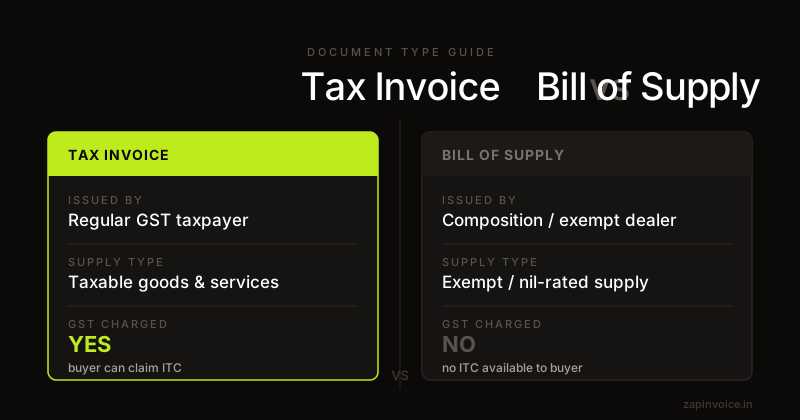
Under GST, every supply requires a document. Which document depends on whether GST is charged:
- Tax Invoice — issued when GST is charged on the supply. The buyer can claim Input Tax Credit using this document.
- Bill of Supply — issued when no GST is charged, either because the supply is exempt or the supplier is a composition dealer. No ITC is available to the buyer.
When to Issue a Tax Invoice
Issue a tax invoice when:
- You are a regular GST-registered taxpayer (not composition)
- The supply is taxable (0%, 5%, 12%, 18%, or 28% GST)
- You are supplying to another GST-registered business (B2B)
- You are supplying to an unregistered consumer (B2C) above ₹2.5 lakh
- You are exporting goods or services (with or without IGST)
When to Issue a Bill of Supply
Issue a bill of supply when:
- Composition Scheme dealers — cannot collect tax from customers
- Exempt supplies — e.g., unprocessed food, healthcare, educational services
- Zero-rated exports with LUT — though technically a tax invoice may also be used with explicit export wording
- Non-GST supplies — goods like petrol, alcohol outside GST
Mandatory Fields Comparison
Tax Invoice — Required Fields
- Name, address, GSTIN of supplier
- Invoice number (sequential, max 16 chars)
- Date of issue
- Name, address, GSTIN of recipient (B2B)
- Place of supply
- HSN/SAC code
- Description, quantity, unit
- Taxable value, GST rate, CGST/SGST/IGST amount
- Reverse charge indicator
- Signature of supplier
Bill of Supply — Required Fields
- Name, address, GSTIN of supplier
- Serial number (consecutive)
- Date of issue
- Name, address, GSTIN of recipient (if registered)
- HSN/SAC code
- Description of goods/services
- Value of supply (after discount)
- Signature of supplier
- Reason why no tax is charged (if not obvious)
Note: A bill of supply has no tax rate or tax amount columns — because no tax applies.
Key Differences at a Glance
- GST charged: Tax Invoice — Yes | Bill of Supply — No
- ITC eligible for buyer: Tax Invoice — Yes | Bill of Supply — No
- Issued by: Tax Invoice — Regular taxpayers | Bill of Supply — Composition / exempt suppliers
- GSTR-1 reporting: Tax Invoice — B2B/B2C tables | Bill of Supply — Exempt supplies table
- Contains tax columns: Tax Invoice — Yes (CGST, SGST, IGST) | Bill of Supply — No
Real-World Examples
Example 1 — IT Consultant (Regular GST Taxpayer)
Ravi is a software consultant in Bangalore, GST-registered. He charges ₹50,000 for a project to a client in Mumbai. Since this is an inter-state service supply, he issues a tax invoice with 18% IGST = ₹9,000. Total invoice: ₹59,000.
Example 2 — Grocery Shop (Composition Dealer)
Priya runs a grocery store in Chennai with ₹80 lakh turnover and has opted for the Composition Scheme. She sells goods worth ₹5,000 to a walk-in customer. She issues a bill of supply — no GST is collected from the customer, though she pays 1% composition levy on her turnover directly to the government.
Example 3 — Doctor (Exempt Supply)
Dr. Sharma runs a clinic. Medical services are exempt from GST. He issues a bill of supply for ₹2,000 consultation fee. No GST applies; no ITC is available to the patient.
Can You Issue Both for One Transaction?
No. A single supply can only attract one document type. However, if a supplier has both taxable and exempt supplies in the same invoice, they may issue a tax invoice showing taxable items with GST and exempt items separately at zero tax — or issue separate documents. The GSTN portal accepts both approaches.
What About Retail Invoices (B2C Small)?
For B2C supplies below ₹2.5 lakh, you can issue a simplified invoice or even a cash receipt instead of a full tax invoice. However, the document must still carry your GSTIN and the GST rate applied. You cannot issue a bill of supply for these if you're a regular taxpayer — you must show the tax.