
Compliance
Debit Note and Credit Note Under GST: Complete Guide (2026)
Issued an invoice with the wrong amount or rate? Here's how credit notes and debit notes work under GST to correct it without violating compliance.
12 Feb 20268 min read

Issue a refund voucher when you need to return an advance to a customer — the supply never happened. Reverses the GST you collected on the original receipt voucher.
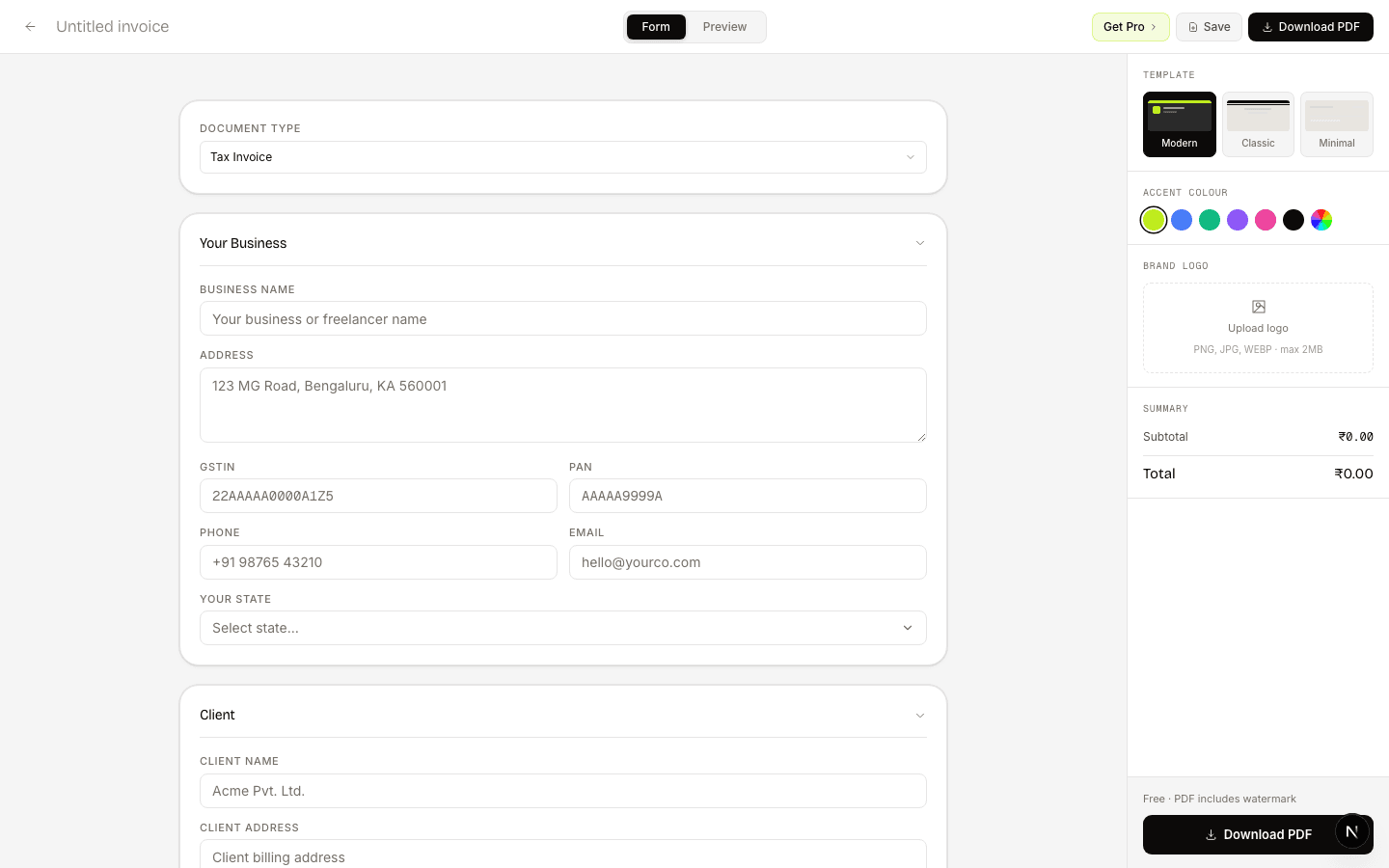
Overview
A refund voucher is issued under Section 31(3)(e) of the CGST Act and Rule 51 when a registered supplier refunds an advance payment it received (and for which a receipt voucher was issued) because the supply is not going to happen.
For services, a receipt voucher collected GST on the advance — the refund voucher reverses that GST by adjusting Table 11B of GSTR-1. For goods, since no GST was collected on the advance (Notification 66/2017), the refund voucher carries no GST adjustment.
The refund voucher must reference the original receipt voucher and is issued on the date the refund is made.
Fields
How it works
Reference the original receipt voucher, customer, amount being refunded, and refund mode.
GST reversal mirrors the original receipt voucher tax split.
Send to the customer and report the refund in Table 11B of your next GSTR-1.
What freelancers say
Switched from Zoho last month — haven't looked back. The CGST/SGST split is automatic, and the one-click GSTR-1 export saves my CA hours at the end of every month.
Had a cross-state client situation I was calculating wrong for months. ZapInvoice just switches to IGST automatically — no more manual guessing, no more wrong invoices.
I bill 15+ clients a month and used to chase every single one. Now ZapInvoice auto-reminds them on day 3, 7 and 14 — most pay before I even notice. Pro pays for itself.
FAQ
Everything you need to know about refund voucher generation.
Yes. When you issue a refund voucher and report it in Table 11B of GSTR-1, your output GST liability is reduced by the GST originally paid in Table 11A — so you effectively recover the tax.
No. A credit note adjusts a tax invoice (completed supply). A refund voucher adjusts a receipt voucher (advance for a supply that didn't happen).
Yes — the original receipt voucher number and date are mandatory. Without the link, the GSTR-1 system cannot match the reversal in Table 11B.
Issue a refund voucher for the partial amount only — reversing the proportional GST. The remaining advance stays on books and gets adjusted on the final tax invoice.
If the original advance was for goods (no GST collected per Notif 66/2017), the refund voucher carries no GST either. For services, GST is reversed in the same proportion as on the original receipt voucher.
Issue it in the same month the refund is made so the GST reversal lands in that month's GSTR-1 Table 11B. Late reversal complicates reconciliation but is allowed up to the annual return deadline.
Free to use
No account needed. Fill in, preview, and download a PDF in under 60 seconds.
Guides
Issued an invoice with the wrong amount or rate? Here's how credit notes and debit notes work under GST to correct it without violating compliance.

Under RCM, the buyer pays GST instead of the supplier. Here is which transactions attract reverse charge, what documents are required, and how to claim ITC.

Place of supply is the single most important concept that determines which GST component you charge. Get it wrong and your buyer loses ITC. Here is how it works for goods, services, and exports.