Skip the manual math: the free GST Invoice Generator derives place of supply and applies the correct CGST/SGST or IGST split automatically.
Why Place of Supply Matters
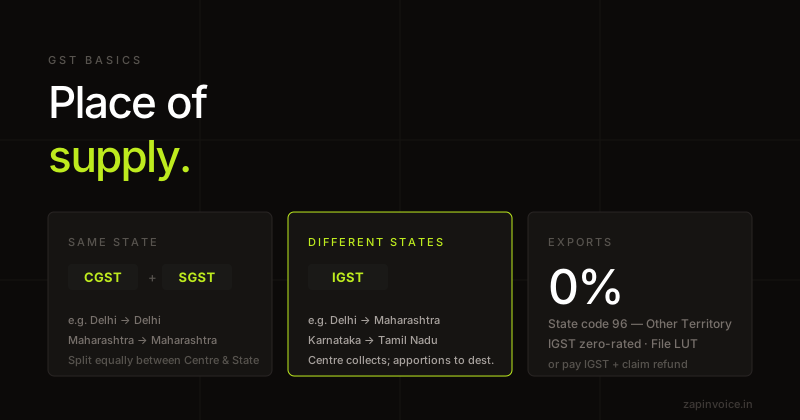
GST is a dual tax — CGST (central government) and SGST (state government) for intra-state transactions, and IGST (central government, later apportioned to the destination state) for inter-state transactions.
The place of supply is the legal test that decides which of these applies. A Delhi supplier selling to a Delhi customer pays 9% CGST + 9% SGST = 18% total. The same supplier selling to a Mumbai customer pays 18% IGST. Same rate, different components, different revenue split between Centre and states.
If you charge the wrong component — say CGST+SGST when you should have charged IGST — the Centre gets both components when the state should have received its share. The buyer's ITC claim may also fail because the tax head does not match their books. The consequences: demand notices, interest, and penalties from the GST department.
The Legal Framework: IGST Act Sections 10–13
Place of supply rules are defined in the IGST Act 2017:
- Section 10: Place of supply for goods other than imports/exports
- Section 11: Place of supply for imported goods
- Section 12: Place of supply for services (where both supplier and recipient are in India)
- Section 13: Place of supply for services (cross-border — either supplier or recipient is outside India)
Place of Supply for Goods
For goods, the rules under Section 10 are relatively straightforward:
General Rule (Section 10(1)(a))
The place of supply is the location where the goods are delivered. If you ship goods from your Delhi warehouse to a customer in Mumbai, the place of supply is Maharashtra, making it an inter-state supply → IGST.
Bill-to Ship-to Transactions
When goods are ordered by Party A (in Delhi) but delivered directly to Party B (in Mumbai), there are actually two supplies:
- Supplier → Party A: place of supply is Delhi (where Party A is located) — CGST+SGST
- Party A → Party B: place of supply is Maharashtra — IGST
Both invoice and delivery can be handled in a single physical movement, but there are two tax transactions.
Goods Assembled or Installed at Site
If goods are assembled, installed, or commissioned at the buyer's premises, the place of supply is where the installation happens (Section 10(1)(b)).
On-Board Supply (Vessels, Aircraft, Trains)
For goods consumed on board a conveyance, the place of supply is the point of embarkation (Section 10(1)(e)).
Place of Supply for Services (Both Parties in India)
Services are more complex because there is no physical delivery. Section 12 has specific rules for different service types:
Default Rule (Section 12(2))
For most services not covered by a specific rule:
- If the recipient is registered: Place of supply = location of the recipient
- If the recipient is unregistered: Place of supply = location of the recipient if known, otherwise location of the supplier
This means a Bangalore-based software developer invoicing a registered Delhi company charges IGST (Karnataka supplier → Delhi recipient = inter-state). If the same developer invoices an unregistered individual in Bangalore, they charge CGST+SGST.
Immovable Property Services (Section 12(3))
Architecture, interior design, construction, real estate agent services — the place of supply is where the property is located, regardless of where the supplier or recipient is registered.
Example: A Chennai architect designs a building in Hyderabad for a Delhi-registered client. Place of supply = Telangana (where property is). The architect charges IGST (Tamil Nadu → Telangana = inter-state).
Restaurant and Catering Services (Section 12(4))
Place of supply = where the restaurant is located (or where catering is provided).
Training and Performance-Based Services (Section 12(5))
Events, training, conferences — place of supply = where the event is held.
Transport of Goods by Road, Rail, Air, Sea (Section 12(8))
For a registered recipient: place of supply = location of the registered recipient.
For an unregistered recipient: place of supply = the origin of the transport.
Passenger Transport (Section 12(9))
Place of supply = the place where the passenger boards.
Telecommunication and Internet (Section 12(11))
Place of supply = location of the subscriber (for registered) or where the service is consumed (for unregistered).
Banking and Financial Services (Section 12(12))
Place of supply = location of the recipient if known; otherwise location of the supplier.
Place of Supply for Cross-Border Services (Section 13)
When either the supplier or recipient is outside India, Section 13 applies:
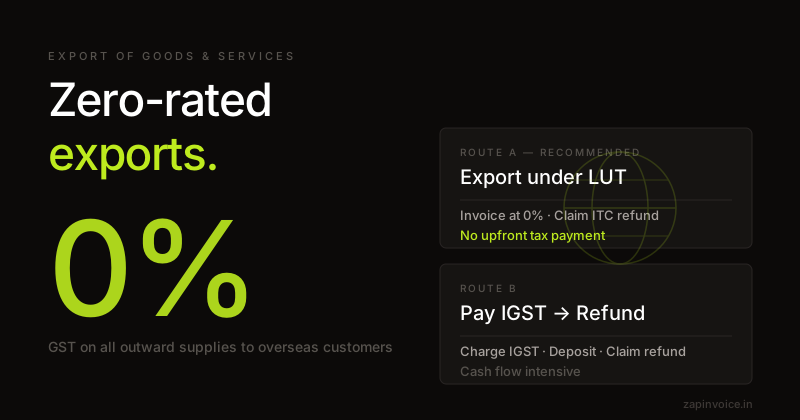
- Default (Section 13(2)): Location of the recipient. For export of services, this is outside India — making it an inter-state supply with IGST (zero-rated with LUT).
- Performance-based services to a non-resident: Place of supply = where the service is actually performed.
- OIDAR services (online databases, software, cloud): Place of supply = location of the recipient. For Indian businesses receiving Google, Adobe, AWS services from abroad: import of services → IGST under RCM.
State Codes Used in Place of Supply
Every GST invoice must mention the state name and 2-digit state code for the place of supply. The first two digits of any GSTIN are the state code:
- 01 — Jammu & Kashmir | 02 — Himachal Pradesh | 03 — Punjab | 04 — Chandigarh
- 06 — Haryana | 07 — Delhi | 08 — Rajasthan | 09 — Uttar Pradesh
- 19 — West Bengal | 20 — Jharkhand | 21 — Odisha | 22 — Chhattisgarh
- 23 — Madhya Pradesh | 24 — Gujarat | 27 — Maharashtra | 29 — Karnataka
- 32 — Kerala | 33 — Tamil Nadu | 36 — Telangana | 37 — Andhra Pradesh
- 96 — Other Territory (exports, SEZ)
How ZapInvoice Handles Place of Supply Automatically
When you enter your GSTIN and your customer's GSTIN (or select states manually), ZapInvoice reads the first two digits of each GSTIN to identify the states. If they match, it applies CGST + SGST in equal halves. If they differ, it applies IGST for the full GST amount. For exports (place of supply = Other Territory, code 96), it switches to the export invoice mode with zero-rated treatment.
This automatic CGST/SGST/IGST split eliminates one of the most common GST calculation errors — no manual lookup needed, no risk of charging the wrong head.