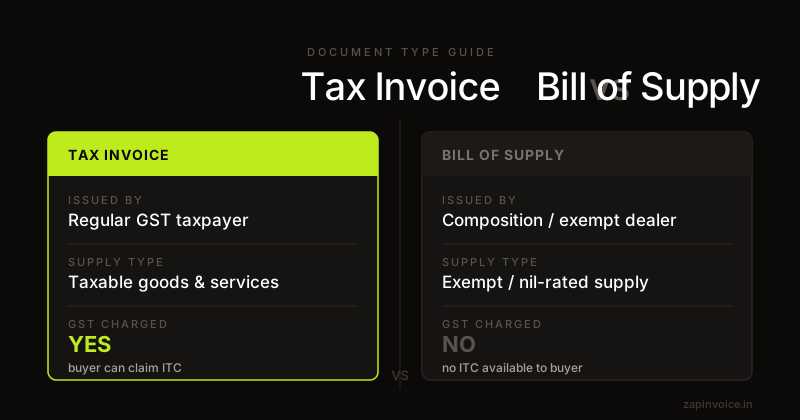
Composition dealer? You must issue a Bill of Supply, not a tax invoice — create one free with the Bill of Supply Generator.
What Is the GST Composition Scheme?
The composition scheme is a simplified GST option designed for small businesses. Under Section 10 of the CGST Act 2017, eligible businesses pay tax as a flat percentage of their turnover — instead of calculating GST at 5%, 12%, 18%, or 28% on each transaction. In return, compliance is dramatically simpler: one annual return (GSTR-4) and quarterly advance tax statements (CMP-08), instead of monthly GSTR-1 and GSTR-3B.
The scheme is entirely optional. You opt in once, and it applies for the full financial year unless you cross the turnover limit or opt out.
Who Is Eligible for the Composition Scheme?
There are two separate schemes — the regular composition scheme (Section 10) and the alternative composition scheme (Notification 2/2019-CT(R)) for service providers:
Regular Composition Scheme (Section 10)
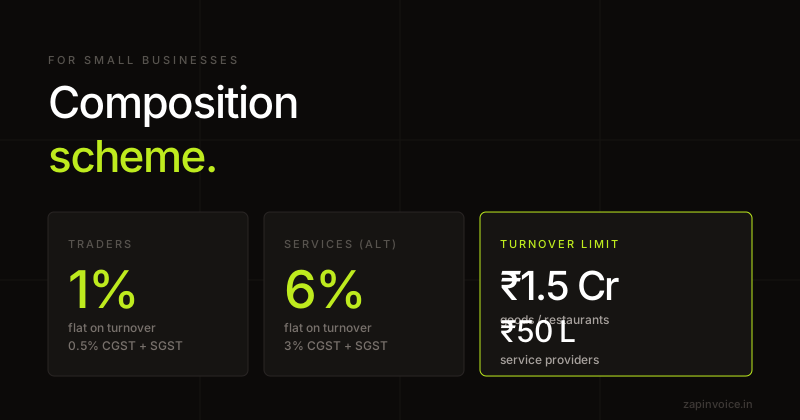
- Goods traders and manufacturers: Aggregate annual turnover ≤₹1.5 crore (₹75 lakh for special category states: J&K, Himachal Pradesh, Uttarakhand, Manipur, Mizoram, Nagaland, Tripura, Meghalaya, Arunachal Pradesh, Sikkim)
- Restaurant services: Aggregate turnover ≤₹1.5 crore
- Must not supply goods/services not leviable to tax under GST
- Must not make inter-state outward supplies of goods
- Must not be an e-commerce operator
- Must not be a manufacturer of notified goods (ice cream, pan masala, tobacco, aerated drinks)
Alternative Composition Scheme for Services (Notification 2/2019)
- Suppliers of services or mixed supply dealers (goods + services) with turnover ≤₹50 lakh
- Inter-state supply of services is permitted
- Pays 6% GST flat (3% CGST + 3% SGST) on all taxable turnover
GST Composition Scheme Rates
The tax under the composition scheme is paid from the business's own pocket — it is not collected from customers.
| Type of Business | CGST Rate | SGST Rate | Total GST |
|---|---|---|---|
| Traders (resellers) | 0.5% | 0.5% | 1% |
| Manufacturers | 1% | 1% | 2% |
| Restaurant services | 2.5% | 2.5% | 5% |
| Service providers / mixed supply (Notif. 2/2019) | 3% | 3% | 6% |
What Documents Does a Composition Dealer Issue?
A composition dealer must issue a Bill of Supply instead of a tax invoice. The Bill of Supply must include the following declaration:
"Composition taxable person, not eligible to collect tax on supplies."
Because no GST is charged on the Bill of Supply, the buyer cannot claim Input Tax Credit on purchases made from a composition dealer. This is often a deal-breaker for B2B businesses who rely on ITC — your B2B customers will prefer regular GST-registered suppliers.
For purchases from other registered dealers, a composition dealer must issue a Payment Voucher and deposit the GST under Reverse Charge Mechanism (RCM) where applicable.
Filing Requirements Under the Composition Scheme
- CMP-08 (Quarterly): A simple self-assessment statement showing turnover for the quarter and the flat-rate tax payable. Due by the 18th of the month following each quarter (July 18, October 18, January 18, April 18). This is also the deadline to pay the tax.
- GSTR-4 (Annual): Annual return covering all four quarters. Due by 30th April of the following financial year (extended to June 30 in recent years). GSTR-4 consolidates all CMP-08 data and reports purchases from registered and unregistered suppliers.
- No GSTR-1: Composition dealers are exempt from filing GSTR-1 (the monthly outward supply return).
- No GSTR-3B: Composition dealers do not file GSTR-3B.
Key Restrictions of the Composition Scheme
- Cannot collect GST: The tax rate is paid from your margin, not added to the invoice.
- No ITC: Input Tax Credit on purchases cannot be claimed — all purchases are a cost to the business.
- No inter-state supply of goods: Only intra-state supply of goods allowed (service providers under Notif. 2/2019 can do inter-state).
- No e-commerce sales: Cannot supply goods through e-commerce platforms that are required to collect TCS (like Amazon, Flipkart).
- No notified goods: Manufacturers of ice cream, pan masala, tobacco, or aerated water are ineligible.
- All registrations included: If you have multiple business verticals under different GSTINs, all must opt for composition — you cannot selectively choose.
How to Opt In to the Composition Scheme
- Log in to the GST portal (gst.gov.in)
- Go to Services → Registration → Application to Opt for Composition Levy
- File Form CMP-02 (the option is automatically effective from the beginning of the next financial year)
- New registrants can opt in at the time of registration by selecting the composition scheme in Form REG-01
Once you opt in, the option is valid for all subsequent years unless you cross the turnover limit or voluntarily opt out by filing Form CMP-04.
Composition Scheme vs. Regular GST: Which Is Better?
The composition scheme works well when:
- Most of your customers are end consumers (B2C) who cannot claim ITC anyway
- Your input tax credit on purchases is small relative to your output tax liability
- You prefer lower compliance effort over tax optimisation
- Your turnover is well below the limit (close to ₹1.5 crore risks breach and forced switch mid-year)
Regular GST is better when:
- You sell primarily to GST-registered businesses who need ITC
- You have significant input costs (raw materials, services) and high ITC accumulation
- You need to make inter-state supplies of goods
- Your turnover is approaching or likely to exceed the limit
Issuing a Bill of Supply — Free Generator
Composition dealers need a Bill of Supply for every transaction. ZapInvoice's free Bill of Supply generator automatically adds the mandatory composition declaration, hides GST columns, and produces a GST-compliant PDF — no sign-up required.